
A Nose for Nonsense
On revisiting my roots in winter and noticing how leaving reshapes what the mind holds on to

More often than not, returning to childhood reveals what has invisibly taken shape along the way. I only understood this once I experienced it firsthand, in the presence of the people who spent so much time with me as a child. That realisation came into focus a month ago, when I went to a primary school reunion.
It still surprises me that enough people agreed to meet again after twenty years. For me, it became a good excuse to return to my roots in eastern Slovakia in winter rather than summer. I flew to Vienna, took a bus to Bratislava, and from there my father and I got into the car and drove for five hours to Vranov nad Topľou. He insisted I drive a manual once in a while, deliberately choosing the most difficult stretch. Highways, according to him, are too boring for me, or so he likes to decide.
We arrived after a foggy drive that occasionally broke into sun as we climbed higher above sea level. My endlessly welcoming aunt immediately filled our bellies with goulash and cakes. Time stretched.
I spent hours talking about the world with my grandfather, who is addicted to YouTube and politics. It felt especially meaningful knowing he has been on this planet for more than ninety years. Somewhere in that conversation, I realised he had been a pioneer in his field, something I had never fully grasped before. I caught myself wondering whether we share a similar drive. At one point he said, “The more you talk, the more I like you.” He seemed genuinely happy that I had returned to reconnect with my roots and wanted to do so more often. We even spoke about hormones, his internal radar lighting up red as he sensed my fertility shifting, while I felt at ease receiving it as a natural transition. He was open to the idea that lived experience can outweigh science. At the same time, he admitted that he would not want to live his prime years in the world we inhabit now, given the level of absurdity he keeps witnessing in politics.
Later that evening, after I returned to my aunt’s apartment, just a minute’s walk away, the night unfolded in two rhythms. My father, uncles, and aunt went out partying. My other aunt and I stayed in, and I went to sleep early, sensing a hormonal shift. A strange flip of generations, softened by the fact that it was a week before Christmas and most of them were moving from one Christmas party to another.
The next day, I got my period and felt noticeably lighter. I arrived at the restaurant for the reunion far too early, at 3:55 PM. Wanting to look cool rather than eager, I walked to the Billa just a minute away and bought chewing gum to pass the time. Then I walked back and went in, right on time.
Our primary school teacher was there too, sitting in the restaurant as if time had barely touched her. She looked exactly the same. I realised I had forgotten the sound of her voice. The moment she spoke, chills ran through me and my heart warmed at the same time. Somehow, many of us appeared unchanged, which felt almost impossible.
And yet, you could sense who everyone had become. The sweet housewives and proud dads. The tired mom who had her first child too early and the second too late, ordering gin and tonic after gin and tonic. The pothead who drinks a little more now. The one who finally said, “Yes, it turns out I’m gay, just like you all sensed.” The policeman confidently explaining drugs without really understanding how they work. The old good friend, now a mother of three, telling us how she once got fined for not wearing a seatbelt while that same policeman sat in his car and watched the whole thing unfold. We laughed hard when she told him, straight to his face, that she had seen him and felt deeply embarrassed. The accomplished director with everything a man is supposed to have. And so on.
As the evening unfolded, a pattern became visible. Out of the sixteen people who came, almost half had left the city to build their lives elsewhere, many of them living as DINKs or on their own. The rest had remained close to where they grew up, layering adulthood onto familiar ground. Listening to them, I noticed something unexpected. Many could recall teachers’ names effortlessly and describe moments from our childhood in precise detail. I struggled to remember most of what they were talking about.
I kept turning this over. Had my brain rewired itself over the years? Perhaps some connections loosened as new ones formed while I moved across Europe, learned new languages, and met new people. Maybe memory settles differently when you remain close to where it first took shape. Or perhaps it is a combination of all this, together with perimenopause, which brings its own neurological shifts. I thought of a line by Gregory Bateson: “The pattern which connects is a meta-pattern.” Sitting there, it felt accurate.
What I was sensing was not absence, but a different configuration. The connections were still there, simply organised around other places, other people, other rhythms. Memory, like identity, felt less like a storage system and more like a living network, shaped by where attention has flowed over time.
As I reconnected with my old classmates, I felt unexpectedly at home and calm. I also met my very first best friend again. She had left too, choosing a different life in Czechia. When she walked into the restaurant, all eyes turned to her. The only thing missing was a fan to blow her hair. She had grown into a real lady, high heels, poise, a kind of radiance that felt earned. At one point, she burst out laughing as she remembered something about me that I had completely forgotten.
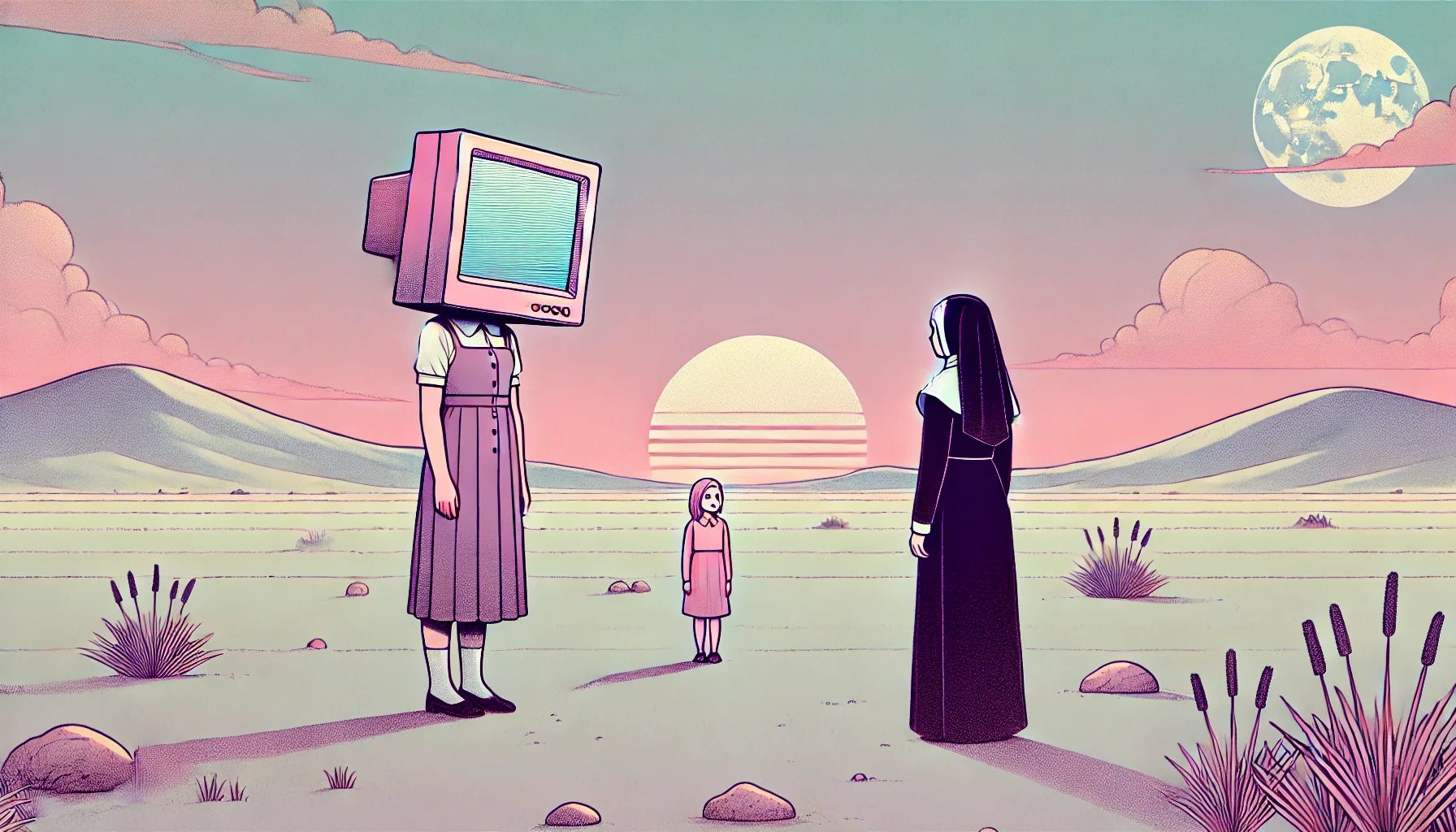
She told me how, in the early years of primary school, I had insisted that my non-religious parents enrol me in religion classes because most of the other children were going and I felt left out. Once there, I apparently spent my time arguing with the nun who taught the class, insisting that the whole idea of religion made no sense. I was angry that nothing added up. She remembers the nun growing increasingly frustrated as I kept disrupting her lessons.
As a child, I did not yet understand that religion is about faith rather than logic. Looking back now, that moment feels formative. It may have been the first visible expression of something I still hold today: a sensitivity to nonsense and a strong urge to make sense of the world. Even though I had forgotten the story, it feels like an early marker.
Once that memory surfaced, others followed. I can now picture that part of my childhood clearly. It makes me feel that the connections we stop visiting do not disappear. They wait. And when we return, they recognise us, leaving us a little more whole.
I want to do this more often.
ADRIANA